

Talk Of The Tongue: Changes That Tell The State Of Your Health
Talk Of The Tongue: Changes That Tell The State Of Your Health
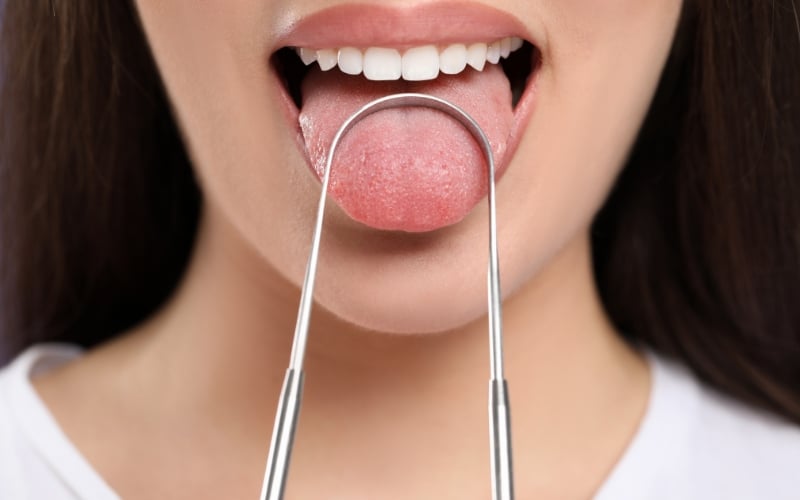
Considered absolutely essential for breathing, speech, as a taste and texture sensor, and allowing food to be swallowed, your tongue is the only group of muscles that work without the support of bone. Tongue prints are as unique as fingerprints – although these dermatoglyphics we each have, are not as distinctive as was once thought.
At least when they’re compared to each other.
Forensic science has long believed that there is little resemblance between the prints of the same person’s index and little finger, for example. That these ‘intra person fingerprints’ are each completely distinctive. So if a perpetrator left prints from different fingers at more than one crime scene, it was never really possible to tie them together.
Not true, apparently. That’s what a new AI study points to (heh).
A network built by scientists at Columbia University was trained on a database of 60,000 fingerprints. Researchers discovered it could predict if any two prints were from the same person with 77% accuracy; a figure that would be higher if the contrastive network that was developed had the input of other prints from the same hand.
Confusing I know; but ultimately it means that potentially, forensic efficiency will increase by more than tenfold. Which is huge. People who’ve been acquitted could consequently be found innocent, and cold cases reopened.
It could set many tongues wagging which only happens because of the muscles of which it consists.
There are said to be eight: intrinsic and extrinsic; four of each. Intrinsic are not attached to any bone, and change the shape of the tongue. Extrinsic are bone-anchored, and direct position movement.
However, Georgia College Professor Emeritus of Biology, Dr Ken Saladin begs to differ. He should know; for the last thirty years, his first anatomy and physiology textbook has been used by university students worldwide. So it’s interesting that the outdated ‘facts’ are still so widely available.
According to the professor, “there is no fixed number that anyone can give.” Those eight muscles are just for starters. The intrinsic muscles that make up the bulk of the tongue are arranged in bundles (fascicles) of muscle fibres, that are variable in number. They can consist of only a few, to more than a dozen.
So there you have it. Finger and tongue misinformation licked.
Microscopically, the tongue surface is an extraordinary topography of thousands of tiny papillae, providing friction and lubrication with a small fraction of them housing taste buds. Of 200,000 to 300,000 of these studs of fringed and bumpy buds, only about 10,000 detect the basic palate sensitivities of salty, sweet, bitter, sour and umami. These flower-shaped tastebuds regenerate every two weeks – which is why burns from hot food or drink recover quickly. And as with many things that ageing takes, tastebuds are included.
The reason elderly people prefer bland foods is because at that point, the 10,000 tastebuds we’re born with have been halved. Which seems almost counter to logic: you’d think that the fewer taste receptors you had, would require stronger, spicier flavours to bring the enjoyment of eating.
As foundational as taste is to human function, it’s not a sense that remains static.
Not only do our palates change from infancy to adulthood, in the last few years Human Molecular Genetics has revealed a reduction in our bitter stimuli response: we enjoy the likes of coffee and alcohol that would have been reflexively rejected by our ancestors.
So facts have changed, we’ve changed, our tongue changes, and within that are changes of which to be aware.
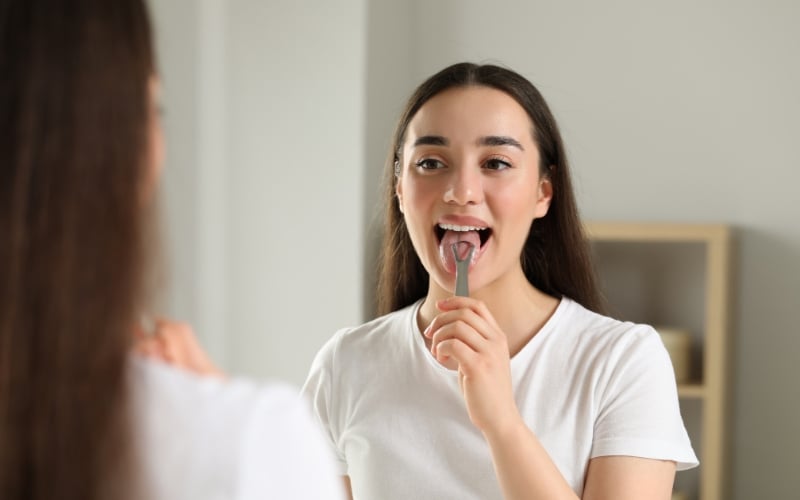
In Traditional Chinese Medicine (TCM) the knowledge that our tongue holds clues to our wellbeing spans continents and millennia. Both it, and oral biology is in agreement that there is no exact description for what is ‘normal’ with no two alike – only guidelines. What is recommended, is becoming familiar with your own tongue – and your children’s – by regularly taking a look at all its tones, textures and surfaces, so that any significant changes will be noticed.
Not all changes are panic-button worthy. Some are harmless that will simply heal of their own accord.
Colour is generally anywhere between pale pink and dark red. Certain medications can cause dark or bluish discolouration, so check with your health provider for any common side-effects.
The true difficulty is that only about 40% of the population regularly sees their dentist. Tongues just don’t get a proper medical assessment. Which is what makes it important to not only be observant, but to make that dental appointment.
Bright red and bumpy can indicate anything from an allergy and vitamin B12 deficiency, to scarlet fever, toxic shock syndrome or Kawasaki disease – which is nothing to do with motorbikes. It generally occurs in children under the age of 5, affects boys more than girls and can cause damage to the heart and blood vessels. Accompanying symptoms include swelling and redness of the hands and feet, irritation and redness of the whites of the eyes, swollen lymph nodes in the neck and a rash.
Obviously medical attention and diagnosis is needed.
Painful white patches that can be scraped off can be a sign of oral thrush which is pretty common across the board and treated with anti-fungal medication.
Roughly 30% of the population will experience what’s known as ‘geographic tongue’. Although it sounds excitedly like suddenly having the ability to speak many languages, it’s rather more pedestrian than that. Painless red patches with a raised white border will appear in different spots and move around: hence the name. The good news it’s benign; the other news is it’s incurable. It is associated with increased stress; and also can point to an autoimmune condition.
Ridged, rippled or ‘scalloped’ indentations along the sides of the tongue is inflammation that’s often not serious. It can be due to dehydration and stress. Certainly, if it’s enlargement of the tongue that’s creating these furrows it’s imperative to seek immediate medical attention.
Like you have to be told that.
Small sores on any of the soft oral tissue are more than likely cankers. They’re caused by a number of things, including food sensitivities and allergies; hormonal shifts, orthodontic or denture irritation. Even biting your own tongue or inside cheek. They can, however, be a sign of celiac or Crohn’s disease and shouldn’t be ignored.
If the papillae grow longer than expected and aren’t being shed (as they normally are), food debris and bacteria become trapped. It a condition more commonly suffered by immunocompromised patients whose systems are unable to deal with the usual oral microbes and consequently, they accumulate. The tongue appears dark brown or black; and often ‘hairy’.
Along with the proper oral hygiene routines of brushing and flossing, it’s definitely worth cleaning your tongue. Gently using your toothbrush with a bit of paste after you’ve done your teeth is sufficient. If you do prefer to use a tongue scraper, don’t overdo it. Too much force can enlarge the papillae and result in tenderness and a white, or fiery red tongue – and nobody likes to be on the receiving end of that.
Overall, rely on nothing but a professional eye with its knowledgable opinion. Otherwise, you could end up completely licked by your own tongue.
DISCLAIMER:
The content has been made available for informational and educational purposes only. New Gisborne Dental House does not make any representation or warranties with respect to the accuracy, applicability, fitness, or completeness of the content.
The content is not intended to be a substitute for professional personal diagnosis or treatment. Always seek the advice of your dentist or another qualified health provider with any questions you may have regarding a dental or medical condition. Never disregard professional advice or delay seeking it because of something you have read or seen on the Site.
Services we mentioned:
Related Articles
What Makes a Thorough Dental Clean? An Honest Guide for Gisborne Patients
Who does a quality dental clean in Gisborne? A quality dental clean involves more than a polish. It includes a clinical examination, periodontal assessment, removal of calculus, polishing, fluoride where appropriate, and personalised home care advice. Book your next...

How Long Do Veneers Really Last? The Timeline Nobody Tells You
Discover the typical lifespan of porcelain veneers and how to make them last. Expert veneer care advice from New Gisborne Dental House.

How Professional Fluoride Varnish Benefits Adult Tooth Enamel Health
Discover fluoride varnish adults benefits for strengthening tooth enamel. Professional fluoride treatments at New Gisborne Dental House serving New Gisborne area.
Why Flossing is Essential for Preventing Tooth Decay Between Teeth
Learn how preventing cavities with floss protects between teeth where brushing can’t reach. Expert preventive care at New Gisborne Dental House.